
VicTESOL Symposium 2023-Presenter Information
VicTESOL Symposium 2023-Presenter Information

Home » VicTESOL Symposium 2023-Presenter Information
VicTESOL Symposium 2023
Event Running Order
Time |
Activity |
Session details |
|||||||
| 8:00am | Registration opens | ||||||||
| 8:45am – 9:00 | Welcome to Country and Introduction | ||||||||
| 9:00am – 9:45am | Session 1 Sustaining EAL expertise: voices from research (Keynote Presentation) |
Keynote Presentation Responsive Mediation and Shifting Novice L2 Teacher Instructional Stance Prof. Karen E. Johnson |
|||||||
| 9:45am – 10:30am | Session 2 Sustaining EAL expertise: voices from leadership (Panel) |
Panel Chaired by: Assoc. Prof. Russell Cross Panelists: Evangelia Kontos, Assoc. Prof. Janet Scull, Amelia Gedye, Michelle Andrews Discussant: Prof. Karen E. Johnson |
|||||||
| 10:30am – 11:00am | Morning Tea | ||||||||
| 11:00am – 12:00pm | Session 3 Sustaining EAL expertise: voices from the classroom (Unpacking of Keynote and Panel) | ||||||||
| 12:00pm – 1:00pm | Session 4 Sustaining EAL expertise: giving voice to everyone (Parallel sessions) |
EAL Teachers: Growing Together and Sustaining Practice Simone Cassidy, Merrilyn Gaulke, Belinda Gillie Kemmer, and Stephanie Dole |
The new EAL Framework Curriculum – Adult sector Nadia Casarotto, Margaret Corrigan, Angela DiSciascio, and Mandy Penton |
Meeting the needs of EAL learners in the VCE Vocational Major and Victorian Pathways Certificate Sarah Douglas |
Digital Literacies in EAL SIG: Teaching and learning EAL in the age of generative AI Dr Katrina Tour, Associate Professor Melissa Barnes, Dr Alexia Maddox, Dr Shem Macdonald, Associate Professor Mark Pegrum |
Unlocking the Power of Early Language Learning: A Closer Look at Finnish Early Childhood Education and Care Prof. Heidi Harju-Luukkainen |
|||
| 1:00pm – 2:15pm | Lunch | ||||||||
| Session 5 Sustaining EAL expertise: giving voice to everyone (Parallel sessions repeated) |
EAL Teachers: Growing Together and Sustaining Practice Simone Cassidy, Merrilyn Gaulke, Belinda Gillie Kemmer, and Stephanie Dole |
The new EAL Framework Curriculum – Adult sector Nadia Casarotto, Margaret Corrigan, Angela DiSciascio, and Mandy Penton |
Meeting the needs of EAL learners in the VCE Vocational Major and Victorian Pathways Certificate Sarah Douglas |
Digital Literacies in EAL SIG: Teaching and learning EAL in the age of generative AI Dr Katrina Tour, Associate Professor Melissa Barnes, Dr Alexia Maddox, Dr Shem Macdonald, Associate Professor Mark Pegrum |
Unlocking the Power of Early Language Learning: A Closer Look at Finnish Early Childhood Education and Care Prof. Heidi Harju-Luukkainen |
||||
| 3:20pm – 3:40pm | Sustaining EAL expertise: voices singing together (Conclusion) | ||||||||
| 3:40pm – 4:30pm | Afternoon Tea & Networking | ||||||||
Session 1 - Sustaining EAL expertise: voices from research
Keynote Speaker
Proff. Karen E. Johnson
Penn State University, USA
Biography
Karen E. Johnson is Kirby Professor of Language Learning and Applied Linguistics at The Pennsylvania State University. Her scholarship has been devoted to building theory and conducting research on L2 teacher cognition within and for the field of L2 teacher education. Grounded in a Vygotskian sociocultural ‘theory of mind’, her scholarship centers on understanding the learning of L2 teaching, the activity of L2 teaching, and the practices of L2 teacher education. She has accomplished this by empirically documenting the dialogic mediation that emerges inside the practices of L2 teacher education, tracing L2 teacher development as it is unfolding, and detailing the consequences of these interactions on the ways in which L2 teachers begin to think about and attempt to enact their instructional practices with L2 students in the socially situated institutions in which they live and work.
Additionally, she has argued that the transformative power of teachers engaging in narrative activities lies in its ability to ignite cognitive processes that can foster L2 teacher professional development and, as a result, critical to the design, enactment, and assessment of the consequences of L2 teacher education.
She has published nine scholarly books, the most recent Praxis-oriented Pedagogy for Novice L2 Teacher: Developing Teacher Reasoning (2023, Routledge). At the core of this book lies a unique set of pedagogical concepts: linguistically compact, conceptually rich chunks of language that function as psychological tools for L2 teaching.
In the MA TESL and the Ph.D. in Applied Linguistics degree programs, she teaches courses in Teaching English as a Second Language, Teaching L2 Writing, Communication in Second Language Classrooms, Theory and Research in Language Teacher Education, and Sociocultural Theory and L2 Learning.
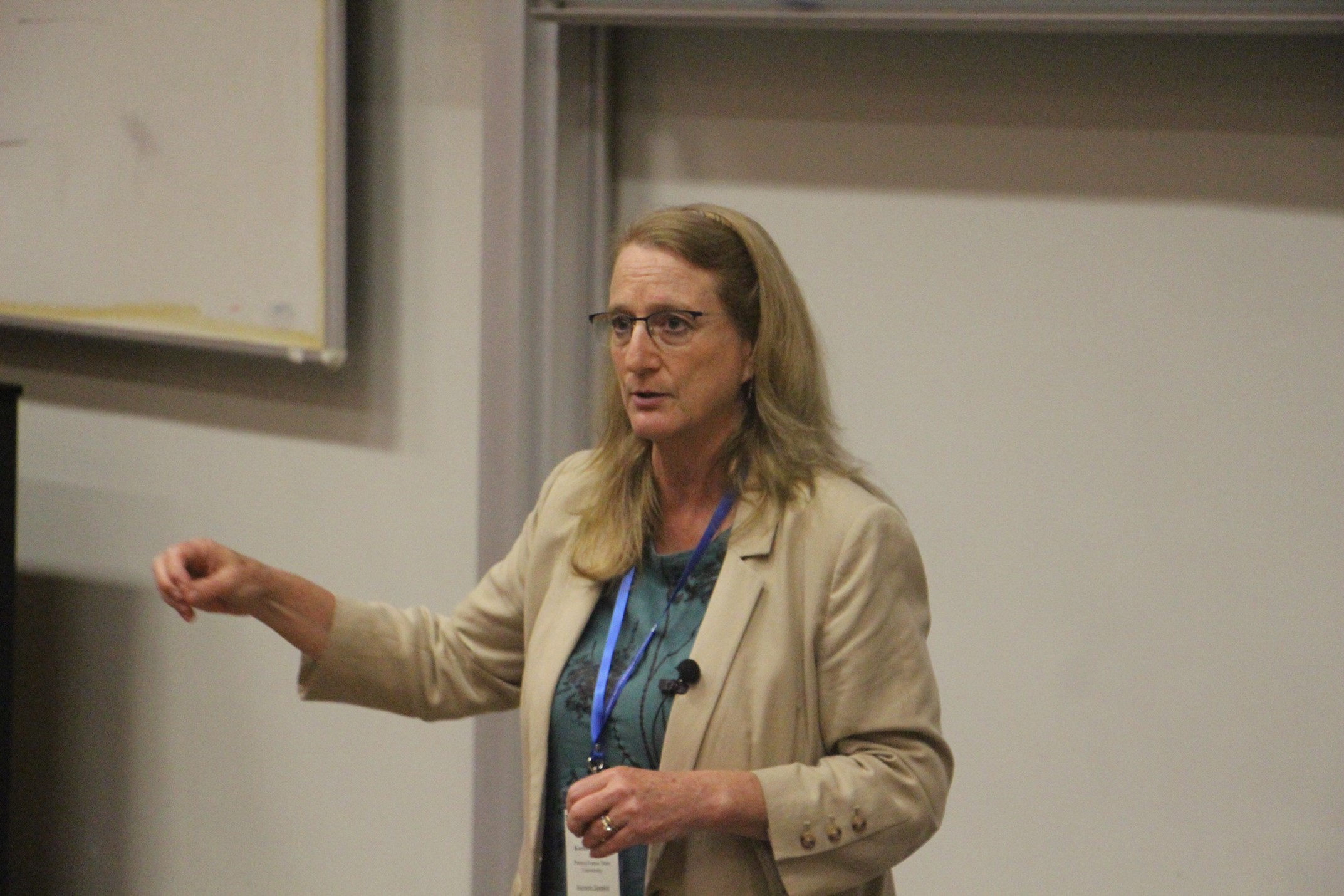
Keynote Presentation: Responsive Mediation and Shifting Novice L2 Teacher Instructional Stance
This plenary provides an insider’s look at the meaningful role that L2 teacher educators and L2 teacher education play in the professional development of L2 teachers through systematic, intentional, goal directed, theorized L2 teacher education pedagogy.
The findings document evidence of a shift in a novice teacher’s instructional stance (i.e., from teacher-centered to teaching as dialogic mediation) and a re-imagined teacher identity (i.e., learner vs. teacher). The findings also document how engagement with particular pedagogical concepts facilitated this novice teacher’s emerging abilities to create and enact meaningful learning environments for her L2 students.
Responsive mediation is positioned as the nexus of mindful L2 teacher education and proposed as a psychological tool for teacher educators to both examine and inform the ways in which they design, enact, and assess the consequences of their own L2 teacher education pedagogy.
Session 2 – Sustaining EAL expertise: voices from leadership
Panel of Experts (Speakers)
Session Overview
Sustaining EAL expertise: voices from leadership
Panel
In this session, Assoc. Prof. Russell Cross will use the keynote presentation from Prof. Karen E. Johnson as a starting point to guide our panellists through a discussion on initial teacher education.
It will be followed up by a response from Prof. Karen E. Johnson who will act as discussant on this panel.
Assoc. Prof. Russell Cross (Chair)
(Melbourne Graduate School of Education)
Russell Cross is Associate Dean for Research at the University of Melbourne’s Faculty of Education, where he previously co-led their Academic Group for Languages and Literacies Education. His research focuses on the sociocultural and political nature of teachers’ work from a Vygotskian perspective, particularly as it relates to teachers’ professional knowledge and learning in content and language integrated learning (CLIL). With Kim Bower, Do Coyle, and Gary Chambers, he recently released Content and Language Integrated Teaching: CLIL in Practice through Cambridge University Press, and his work has appeared in Modern Language Journal, J Teacher Education, and Language Teaching Research, among others. Russell is former co-editor of TESOL in Context and a member of their current Editorial Board.
Assoc. Prof. Janet Scull (Panelist)
(Monash University)
Janet Scull is an Associate Professor at Monash University with a particular interest in language and literacy subjects in both undergraduate and postgraduate degree programs. Her research interests focus on the areas of language and literacy acquisition, literacy teaching and assessment and practices that support the continuity of children’s literacy learning across early childhood settings and the early years of schooling. Janet has also contributed to the design and evaluation of approaches to literacy teaching, for students from a range of culturally and linguistically diverse backgrounds. More recently she has examined the relationship between early literacy and children’s connectedness and engagement with school.
Amelia Gedye (Panelist)
(Blackburn English Language School)
Amelia is a language learner and EAL teacher. She started her teaching career in 2016, teaching EAL in the adult sector at Carringbush Adult Education, AMES, and Kangan. She has also worked overseas in Japan, teaching English to university students. In 2022, Amelia completed a Master of Teaching Secondary at La Trobe University and, since then, has been working at Blackburn English Language School as part of the New Arrivals Program. As a recent graduate, Amelia is currently completing an inquiry cycle as part of her full registration with VIT. She has a background in social work and is passionate about supporting EAL students to develop their linguistic and social capital.
Evangelia Kontos (Panelist)
(Blackburn English Language School)
Evangelia (Leah) Kontos is the Assistant Principal at Blackburn English Language School, Whitehorse campus. After completing her studies in TESOL, she began working in the Northern Region New Arrivals Program teaching newly arrived secondary students. She has taken different leadership roles including Learning Specialist and Professional Learning Leader (New Arrivals Program) and the AIZ (Achievement Improvement Zone) Leader in mainstream schools. She has participated and facilitated different projects like Creativity in Schools for new arrival students to promote agency and active learning. She has recently led teachers through extensive training in using functional grammar and has supported implementation of strategies to teach functional language explicitly across the curriculum. She is a passionate teacher and she likes to inspire her EAL/D students to become lifelong learners.
Michelle Andrews (Panelist)
(Department of Education)
Michelle Andrews is a Senior Project Officer with the EAL Unit in the Department of Education. An experienced Primary teacher and TESOL specialist, she worked for over 12 years in the new arrivals program at Blackburn English Language School, undertaking a variety of teaching and leadership roles. More recently, she spent 6 years establishing and coordinating the EAL program at Preston North East Primary School. She moved into her current role late last year, motivated by her passion for building teacher capacity and supporting and strengthening educational outcomes for EAL learners. Her work with the EAL Unit focuses primarily on projects and resources to support the teaching of English as an additional language in Victorian government schools.
Session 3 – Sustaining EAL expertise: voices from the classroom
Unpacking of Keynote and Panel (Facilitators)
Randomised rooms to enable cross sector discussions facilitated by VicTESOL Committee members
Sessions 4 and 5 – Sustaining EAL expertise: giving voice to everyone
Parallel sessions (speakers)
Simone Cassidy (Department of Families, Fairness and Housing), Merrilyn Gaulke (Bendigo Crusoe College), and Belinda Gillie Kemmer (Bendigo Crusoe College)
EAL Teachers: Growing Together and Sustaining Practice
Please join us to hear from regionally based EAL teachers as they share their insights on developing good teaching practices and sustaining expertise through the power of mentoring and collaboration. This session aims to inspire educators by shedding light on effective strategies for nurturing excellence within the EAL teaching community.
Together, we will discuss the challenges and rewards of creating a supportive network of colleagues and mentors, and fostering an open culture for sharing ideas and resources. Attendees can expect to gain valuable insights into how mentoring and collaboration can positively impact their own teaching practices and sustain EAL expertise over time.
Biographies
Simone Cassidy
Simone Cassidy is an Education and Training Advisor in the Refugee Minor Program (RMP), Department of Families, Fairness and Housing. The RMP provides case management support to young people who have entered Victoria as refugees and are without their parents. The majority of children and young people in the program have experiences of disrupted education or have arrived with little or no formal education. Simone works with young people from their time of arrival in Australia until they exit secondary school and begin on the next step in their education journey. Through working with more than 50 schools across Victoria and directly with young people in the RMP, Simone has developed insights into how varying supports, systems and attitudes impact the experiences of young people from refugee backgrounds as they navigate the complex world of post-school study options. Formerly a teacher, Simone combines knowledge of the academic needs of English as an Additional Language (EAL) learners with an understanding of the psychosocial supports which allow refugee-background students to thrive.
Merrilyn Gaulke
Belinda Gillie Kemmer
Stephanie Dole
Stephanie has been working in the EAL space for the last 10 years and is very passionate about supporting EAL learners. She taught in the Northern Territory for 6 years working in classrooms that had high proportions of EAL students and completed her Masters of TESOL while working there. More recently she has continued her work in Bendigo as an EAL teacher and has now taken on the role as the EAL Cluster Coordinator. In this role, she works within the Bendigo region to help build schools, teachers and staff capacity when working with EAL students.
Nadia Casarotto (Victoria University), Margaret Corrigan (Carringbush Adult Education), Angela DiSciascio (Gordon Institute of TAFE)
The new EAL Framework Curriculum – Adult sector
In this session you will learn about the new Victorian EAL Framework curriculum and how to apply it to your teaching. The session will provide an overview of the new curriculum as well as information on how to unpack a unit of competency. The workshop will also include hands-on activities on applying the new curriculum to your teaching practice. If you don’t teach in the adult sector, don’t be put off coming to this session…Come and learn from your TESOL colleagues about how curriculum is applied in the adult sector!
Biography
Nadia Casarotto
Nadia is one of the Curriculum Maintenance Managers (CMM) based at Victoria University. The Curriculum Maintenance Manager (CMM) service is provided on behalf of the Victorian State Government and supports the Vocational Education and Training system across a number of industries. As the General Studies and Further Education CMM, Nadia monitors and manages the accreditation of a range of foundation courses including language, literacy and numeracy crown copy accredited courses. These include the Certificates In General Education for Adults (CGEA) and the English as an Additional Language (EAL) Framework. Nadia has a background in EAL and adult literacy and has worked in the VET sector over a number of years in different roles.
Margaret Corrigan
Margaret, current President of VicTESOL, is CEO of Carringbush Adult Education, a not-for-profit training provider in inner-city Melbourne. She has over 30 years’ experience in a range of educational settings in Australia and the Asia – Pacific region. She is passionate about improving outcomes for learners through supporting teachers with professional learning.
Angela DiSciascio
Angela Di Sciascio has worked in the adult EAL sector for over twenty years and is currently teaching at Gordon TAFE in Geelong. She is Chair of the Victorian EAL Framework Adult Sector Advisory Group and Vice President of VicTESOL.
Mandy Penton
Mandy is the Curriculum Maintenance Manager for General Studies, Further Education, Transport and Distribution and is an experienced vocational educator and leader working across different vocational and educational settings. For many years Mandy has managed the development and implementation of National training package qualifications, ASQA and VRQA qualifications across a wide breadth of vocational sectors, with a focus on meeting the current and emerging needs of learners for positive employment and /or educational outcomes.
Sarah Douglas
(River Nile School)
Meeting the needs of EAL learners in the VCE Vocational Major and Victorian Pathways Certificate
This workshop will explore ideas for developing curriculum and assessment practices to meet the needs of EAL learners completing the VCE Vocational Major and Victorian Pathways Certificate.
VCAA explains that: ‘The VCE Vocational Major (VM) is a vocational and applied learning program within the VCE designed to … give students greater choice and flexibility to pursue their strengths and interests.’
‘The Victorian Pathways Certificate (VPC) is an inclusive Year 11 and 12 standards-based certificate that meets the needs of a smaller number of students who are not able or ready to complete the VCE (including the VCE Vocational Major).’
The workshop will share how River Nile School has developed VCE VM and VPC programs to support young women from refugee and asylum seeker backgrounds to complete senior secondary education while building essential language, literacy, numeracy and life skills to pursue further education and work.
Participants will have the opportunity to learn about the VCE VM and VPC and consider how schools and teachers can meet the needs of EAL learners enrolled in these certificates in a range of education settings.
Biography
Sarah is the Leading Teaching for EAL, Literacy and Numeracy at River Nile School where she leads the development of curriculum, assessment and teaching practices which support young women from refugee and asylum seeking backgrounds to access senior secondary education through the VCE Vocational Major and Victorian Pathways Certificate (previously VCAL). Prior to this she worked as a teacher in a range of settings and a teacher coach and mentor in Victoria and the Northern Territory. She is also currently completing a Master of Education at the University of Melbourne with a focus on Literacy Education.
Dr Katrina Tour (Monash University) and Associate Professor Melissa Barnes (LaTrobe University)
Digital Literacies in EAL SIG: Teaching and learning EAL in the age of generative AI
The rapid growth of generative AI tools, including ChatGPT, in the last year has enormous implications for education more generally and EAL education, in particular. Join Digital Literacies in EAL SIG event in which invited speakers discuss the potential and challenges associated with the use of generative AI in EAL settings.
Session 1: Panel discussion – Generative AI in EAL learning: promises and challenges
Panel members: Dr Alexia Maddox (La Trobe University), Dr Shem Macdonald (La Trobe University) and A/P Mark Pegrum (The University of Western Australia)
This panel discussion, featuring AI and EAL experts, explores the role of generative AI in EAL teaching and learning. Discussion will include topics such as a plethora of AI tools available for language learners; students’ and teachers’ roles in learning with AI, AI literacies; practical and ethical challenges associated with the use of AI in linguistically and culturally diverse classrooms. Join us to learn about the latest developments in AI and education and to engage in a thought-provoking discussion on this important topic.
Session 2: Teachers’ voices on generative AI in EAL settings
Dr Katrina Tour (Monash University) and A/P Melissa Barnes (La Trobe University)
Generative AI platforms, such as ChatGPT, have already changed (and continue to change) different domains of life, work and learning, undoubtedly creating both opportunities and challenges. With the rapid adoption of AI by organisations and individuals, AI education and AI literacies are becoming increasingly important in everyday life, learning and work. They are especially significant for adult EAL (English as an Additional Language) learners, with teachers playing a crucial role in helping learners to develop capabilities associated with understanding and applying AI. This presentation reports initial insights from a recent research project exploring what EAL teachers think about the use of such tools within EAL settings and the potential of generative AI for language learning.
Biographies
Dr Alexia Maddox is a Senior Lecturer in Pedagogy and Education Futures at La Trobe University. She has a background in the sociology of technology and specialises in researching digital frontiers and socio-technical transformation. Her most recent research draws together insights into emerging technology spaces with immersive environments/sensory experiences and technology trends surrounding artificial intelligence, machine learning, algorithmic processes, Web3 gamification and play. Alexia combines a long-term interest in the social impacts of the internet with practical questions about human-technology encounters and how to research them.
Dr Shem Macdonald is a committee member of VicTESOL and a lecturer in language education working with teachers in pre- and in-service programs in the areas of TESOL, languages and multilingual education. His recent research includes a study of university academic learning support staff and their understanding of the issues around generative AI in university learning.
Associate Professor Mark Pegrum works within the Graduate School of Education at The University of Western Australia, where he is the Deputy Head of School (International). He specialises in digital technologies in education, with a particular focus on mobile learning. His current research focuses on mobile and emerging technologies, including extended reality (XR) and generative artificial intelligence (AI); digital literacies and especially attentional literacy; and the forms digital learning takes in diverse contexts across the Global North and South.
Associate Professor Melissa Barnes works within the School of Education at La Trobe University. Her teaching focus and research interests are situated within the fields of teacher education, pedagogy, assessment, policy and TESOL. Recent research projects include an examination of teacher education policy reforms and school, family and community partnerships supporting families from refugee backgrounds.
Dr Katrina Tour a Senior Lecturer in the Faculty of Education at Monash University. Her research focuses on the digital literacies of refugees and migrants, and investigates the ways in which these groups use digital technologies in EAL (English as an Additional language) for life, learning and employment. Katrina’s research projects in EAL contexts have examined innovative teaching and learning with technologies, including the use of generative AI, teachers’ experience with digital literacies, digital multimodal composing and technology use in refugee communities.
Prof. Heidi Harju-Luukkainen
(University of Jyväskylä, Finland, and Nord University, Norway)
Unlocking the Power of Early Language Learning: A Closer Look at Finnish Early Childhood Education and Care
The Finnish education system has gained significant international attention for consistently achieving high rankings over many years. However, this attention has not been extended to the country’s early childhood education system. Nevertheless, in Finland, early childhood education and care are considered vital components of their education system, playing a crucial role in a child’s learning, development, and lifelong learning journey.
Across all Nordic countries, there has been a rapid increase in the number of languages spoken in early childhood education settings. Today, it is widely acknowledged that bilingualism and multilingualism are valuable assets in a globalized world. Being able to communicate in different languages fosters greater understanding and connection between countries and people. However, different countries vary in their support for early language learning, which can reflect their attitudes and ideologies towards languages and language learning. In Finland children are given multiple possibilities for language learning, starting from early years.
In this presentation, I will delve into the fundamental aspects of Finnish early childhood education and primary education systems. Additionally, I will showcase the various language learning opportunities available for children, starting from their early childhood education years. The insights presented in this talk will be based on the significant findings from the book titled “Finnish Early Childhood Education and Care – A Multi-theoretical Perspective on Research and Practice.”
Biography
Heidi Harju-Luukkainen is a full Professor of Education at both the University of Jyväskylä in Finland and the Nord University in Norway. At the University of Jyväskylä, she also serves as the Vice Director of the Campus called Kokkola University Consortium Chydenius and holds the position there as the Director of Educational Sciences, which includes responsibilities for class teacher education, special teacher education, and early childhood teacher education. In addition, she is a member of the University of Jyväskylä educational council. Professor Harju-Luukkainen holds a PhD in Education, a Qualification in Leadership and Management, and Special Education Teacher and Subject Teacher Qualifications from Finland. She possesses extensive international experience, having worked in five different countries, and worked in esteemed institutions such as the University of California, Los Angeles (UCLA), University of Southern California (USC), University of Gothenburg, and University of Helsinki.