VicTESOL Symposium Resources

VicTESOL Symposium 2024 Resources

Refugee education in Australia: what helps, what hinders and what needs to change

Dr Melanie Baak (UniSA)

Facilitator:
April Edwards (University of Melbourne)

Panel Members:
Sarah Cunningham (Catholic Care), Debra Gibson, (Doveton College P-9), Christine Bakopanos, (The Victorian Foundation for Survivors of Torture- known as Foundation House), Houda El Kheir (Meadows Primary School)

Lindsey Hogg (Foundation House), Allison Greene (Foundation House)

VicTESOL Symposium 2023 Resources

Keynote Presentation: Responsive Mediation and Shifting Novice L2 Teacher Instructional Stance

Prof. Karen E. Johnson (Penn State University, USA)

Keynote Response, Panel: Sustaining EAL expertise: voices from leadership

Unpacking of Keynote and panel sessions

Facilitated by various VicTESOL Committee members

Growing Together and Sustaining Practice

Simone Cassidy (Department of Families, Fairness and Housing), Merrilyn Gaulke (Bendigo Crusoe College), and Belinda Gillie Kemmer (Bendigo Crusoe College)

Nadia Casarotto (Victoria University), Margaret Corrigan (Carringbush Adult Education), Angela DiSciascio (Gordon Institute of TAFE)

Dr Katrina Tour (Monash University), Associate Professor Melissa Barnes (LaTrobe University), Dr Alexia Maddox (La Trobe University), Dr Shem Macdonald (La Trobe University) and A/P Mark Pegrum (The University of Western Australia

Unlocking the Power of Early Language Learning

Prof. Heidi Harju-Luukkainen (University of Jyväskylä, Finland, and Nord University, Norway)

Organisations at the 2023 VicTESOL Symposium

Use this column for supporting copy about partner organisations and linked resources.

VicTESOL Symposium 2022 Resources

Professional Identity in TESOL? Finding Common ground

Prof. Ben Rampton (Kings College London), Dr Mel Cooke (Kings College London)

Panel of Experts: Finding the Common Ground

Chair: Assoc. Prof. Russell Cross (Melbourne Graduate School of Education)

Panelists: Rebecca Paic (Catholic Education Commission Victoria), Angela DiSciascio (Gordon Institute of TAFE), Mairead Hannan (Collingwood English Language School), Peter James (Richmond West Primary)

Discussants: Prof. Ben Rampton (Kings College London), Dr Mel Cooke (Kings College London)

Unpacking of Keynote and panel sessions

Facilitated by various VicTESOL Committee members

Learning Through Languages: Plurilingual Pedagogy in the English Classroom

Michelle Andrews (Preston North East Primary school), Hien Webb (Collingwood English Language School), and Assoc. Prof. Marianne Turner (Monash University)

Impacts of Traumatic Refugee Experiences on Learning and Behaviour

Allison Green and Matt Roger (Foundation House)

Reframing Early Childhood educator professional learning needs in culturally and linguistically diverse early childhood contexts

Dr Yvette Slaughter (Melbourne Graduate School of Education), Dr Gary Bonar (Monash University), Dr Anne Keary (Monash University)

Panel of Experts: The ACTA EAL/D Roadmap

Chair: Margaret Corrigan (Carringbush Adult Education)

Panelists: Facilitated by Margaret Corrigan
Dr Michael Michell (University of New South Wales), Mark Melican (Blackburn English Language School), Assoc. Prof. Rod Neilsen (Deakin University)

LWA and Languages and Multicultural Education Resource Centre (LMERC)

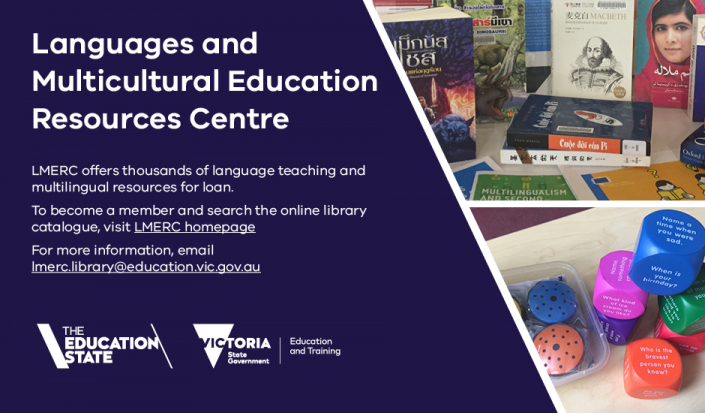
VicTESOL were pleased to showcase the above organisations at our 2022 Symposium. Please click the images on either side for further information on LWA and LMERC, and the resources they offer.

Languages and Multicultural Education Resources Centre LMERC.

VicTESOL Symposium 2019 Resources

VicTESOL Symposium 2019: Sharing multiple perspectives on TESOL

Introduction – Dr Shem Macdonald

Download (PDF, 1.73MB)

Download (PDF, 1.73MB)

Keynote Speaker: Dr Marianne Turner, Monash University

Exploring the ‘SOL’ in ‘TESOL’: Leveraging and developing students’ linguistic repertoire Download (PDF, 1.49MB)

Download (PDF, 1.49MB)

Panel of Experts: Plurilingual perspectives and their implications for teaching

Dr Shem Macdonald – VicTESOL – Moderator
Dr Marianne Turner – Monash University
Dr Julie Choi – University of Melbourne
Dr Howard Nicholas – La Trobe University

An awareness, understanding, acceptance, and embracing of the plurilingualism of learners in TESOL programs can positively shape how we teach and how they learn. The fact that plurilingualism features prominently as a new strand in the Draft English as an Additional Language Curriculum as part of the Victorian F-10 Curriculum suggests that this claim bears some weight. However, do we, as TESOL professionals, have a clear idea what plurilingual perspectives are and what their implications are for teaching language?

To explore this question, we invited several experts in the field of TESOL/Applied linguistics to a panel discussion to share their perspectives on plurilingualism. We asked them to outline some of the implications of such views for how teachers of EAL might approach their planning and teaching.

Early Childhood & Primary

Carolyn Elliot, Principal, Doncaster Gardens Primary School

‘I can rather than I can’t’ – supporting students, families and teachers to achieve continued growth

Kate Plant, EAL leader, Newbury Primary School

Establishing an EAL program in a mainstream primary school

Fiona Ackerly, Susan Govett, and Brooke Henderson with Margaret Nutbean

Teaching Young Children in English in Multilingual Contexts (TYCEMC)

Adult & Community

Jodie Whitehurst, Williamstown Community and Education Centre

Using Drama Techniques in the teaching of adult EAL

Jigar Adhyaru, Chisholm TAFE

SWOT analysis of digital literacy in EAL class for adults

Across the Sectors

Steven Quinn, Carwatha Secondary College

Talk with the hand: Gestures in EAL

Nathan Chong, Brunswick English Language Centre & Clare Blackman, Blackburn English Language School

Flash Presentation and Round-table Discussion: Using Technology in the EAL classroom

If you are having difficulty downloading any of these files, please email plcoordinator [at] victesol.vic.edu.au to receive the file via email.

Languages and Multicultural Education Resource Centre (LMERC)

LMERC is a DET lending library and resource advice service for a wide range of educators across all educational levels and sectors in Victoria. LMERC provides free postage to government schools outside of the metro area.

TESOL educators participating in a collaborative professional learning session.

The collection focus:

  • English as an Additional Language (EAL)
  • Languages
  • Cross curriculum priority areas (with emphasis on Aboriginal and Torres Strait histories and Cultures and Asia and Australia’s engagement with Asia)

Core functions:

  • Provide specialised resources in all formats for loan (12 week for teachers, 6 weeks for students)
  • Inform teachers about new resources at LMERC and online at the library and through the LMERC newsletter (4 issues per year)
  • Provide presentations to pre-service teachers and other groups about LMERC and resources

LMERC – Level 1, 189 Faraday Street, Carlton – 03 9349 1418

LMERC information – Introduction to LMERC video – LMERC catalogue – Subscribe to the LMERC newsletter

VicTESOL would like to thank the Department of Education & Training Strategic Partnerships Program for supporting the VicTESOL Symposium.

VicTESOL Symposium 2018 Resources

Teaching and Learning Cycle Presentation Recordings

Amelia Gedye, Carringbush Adult Education

Barbara Dahlsen & Rebekah Jones de Villagran, Blackburn English Language School

Jessie Sambell, Blackburn English Language School

Rebecca Robinson, River Nile School

Presentations

VicTESOL Symposium 2017 Resources

Keynote Presentations

Dr Jenny Barnett

Making use of professional standards in EAL/D

Associate Professor Jane Wilkinson

Building bridges between schools and everyday learning spaces for refugee students: A praxis-oriented approach to professional learning

Session Recordings

Dr Alan Williams

Pedagogy

Summary

Dr Alan Williams presented a very comprehensive overview of the TEAL website and practical components for teacher assessment. Anecdotes of the development of the site were given as was background information regarding the establishment of the tools and the collaborative nature of the resources. Alan suggested that the tools are adaptive to your cohort of students and/or institution for both Primary + Secondary schools.

Alan articulated that the TEAL tools were established not only for supporting EAL teachers to assess their students’ language abilities but also for providing suggestions on how to support students with the next steps. The tools enable teachers to map their students’ progress over time and as such can be used in the collection of longitudinal data. Finally, Alan implored participants to be vocal in making suggestions to the TEAL creators on how they can further support teachers in their assessment. One suggestion was to upload student work samples through the ‘benchmarking forum’.

Summary contributed by Julia Lippold (VicTESOL Committee Member)

Dr Ekaterina Tour, Dr Maria Gindidis, Jess McCulloch & Janine Breadmore

Research/Digital Technologies

Summary

This well attended morning session proved to be very inspiring to every participant, especially in relation to the effective use of digital technology for teaching EAL literacies to Year 7 refugee students. Within half an hour of allocated time, the presenters gave a well-planned glimpse of their collaborative action research into the trans-media storytelling as an innovative pedagogical approach. The enthusiastic audience responded with further queries and thanked them wholeheartedly for a fast paced but very informative session.

Summary contributed by Manalini Kane (VicTESOL Committee Member)

Rosemary Abboud

Leadership

Summary

Experienced EAL teacher and leader Rosemary Abboud recounted her journey in establishing an EAL program for students at Dandenong North Primary School. From her very first questions about how language is learned, and what supports are required to do this successfully, we followed her through the thinking and planning involved at each stage, and heard what she had implemented to develop and build a differentiated and effective EAL support program. Along the way, she discussed leadership, sharing what she had learned through the process.

Rosemary presented thoughtful insights and advice about building constructive relationships, developing opportunities and resourcing colleagues which will be particularly useful for EAL teachers working in mainstream settings, who are often set the task of developing similar programs, and frequently required to take on responsibility for the leadership of EAL within their own school.

Summary contributed by Michelle Andrews (VicTESOL Committee Member)

Session Presentations & Summaries

Powerpoint

Download (PPTX, 6.02MB)

Session Summary

What a wonderful and thought-provoking session this was! Margaret shared her wealth of knowledge in the area of mentoring mainstream teachers on how to work with EAL students through the analogy of the fairy-tale Cinderella.

Following on from an overview of her broad professional experience in roles as a New Arrivals teacher, Literacy Coach, Melbourne University Lecturer and now consultant, she revealed to us her words of wisdom for when we work with mainstream teachers:

  • Be kind and generous (to those we work with)
  • Be brave and risk-take (by building colleague’s self-esteem whilst challenging them)
  • Take setbacks as challenges (as everyone evolves at a different pace)
  • Believe in oneself (as EAL practitioners who understand language acquisition)
  • Keep learning (by researching for new and better ways)
  • Never stop dreaming (that we can all make a difference to teachers and students lives)

Summary contributed by April Edwards (VicTESOL Secretary)

Powerpoint

Download (PPTX, 427KB)

Session Summary

31% of current undergraduate Early Childhood Education students at Monash University are international students from China. Haoran Zheng’s session helped us understand the background, motivation and needs of this group better. We discussed some childhood experiences and games which challenged the teachers on their practicum, such as “finger knitting”, and why children can be particularly difficult for international students to understand. –

Summary contributed by Catherine McClymont (VicTESOL Professional Learning Co-ordinator)

Session Summary

This session covered the effective use of digital technology in relation to the synchronous teaching and learning via video conferencing.

Voula MacKenzie aptly but briefly introduced the program. Following that, Nathan did an extensive presentation covering how the virtual EAL program for the new arrivals in the remote areas of Victoria is delivered through a distance education model at the Victorian School of Languages. The in-depth information on the components that make up the virtual learning environment effective and engaging, proved to be very stimulating for every participant.

Summary contributed by Jessie Sambell (VicTESOL Committee Member)

Session Summary

One does feel so humbled when listening to the important work that an EAL leader such as Mairead Hannan does. By reflecting on her own educational journey and musical and teaching career she provided the audience with a sensitive interpretation of living and learning as an EAL student in the St Joseph’s Flexible Learning Centre. She shared with us the tenets of the Maree Program – a flexible program run for 15-25 year old EAL learners who are disengaged or have fallen through the cracks in the educational system. On learning that the Berry St pastoral care model guided many of the practices and that the Edmund Rice Education Australia oversaw the Program, many of us in the audience were led to marvel at the noble and key social and educational role Mairead plays with her staff in supporting over 450 EAL learners so very much in need. Summary contributed by April Edwards (VicTESOL Secretary)

Session Summary

Mums and Bubs English Classes

Following recent settlement of refugee groups in the Bendigo area, the Loddon Campaspe Multicultural Services identified a need for everyday English classes, particularly for refugee women who were unable to access TAFE or AMEP programs because they were home caring for small children. In response, the Mums and Bubs English classes began three and a half years ago. At the VicTESOL Symposium, Robyn Spandonide and Ellie Akbari gave us an interesting insight into the program’s development and scope, and its positive impact on both the mothers and children, both in learning English, and more broadly in building confidence, connection and integration into the community. The effect of this program was a reminder to all sectors of the importance of knowing the community and responding in creative and practical ways to their particular learning needs.

Summary contributed by Michelle Andrews (VicTESOL Committee Member)

Session Summary

Most international students are already using social media for their own purposes, and many teachers try to harness this enthusiasm to increase connection within a class, with mixed results. Jade Sleeman’s session examined some case studies with students’ reactions to the use of social media in a class. She gave some tips on how to encourage constructive use of social media to increase class cohesion. Her research shows that guidelines and modelling are required from the teacher, but social media can have a positive effect on students’ sense of connection in a class.

Summary contributed by Catherine McClymont (VicTESOL Professional Learning Co-ordinator)

Session Summary

The Pronunciation workshop with Margaret Corrigan and Liz Keenan was an opportunity for participants to see in action some of the effective pronunciation strategies that are used at Carringbush Adult Education in Richmond.
Teaching pronunciation is a challenging task but not for Margaret and Liz and their team at Carringbush! They both demonstrated their passion and dedication through their ongoing research, learning practice and effective collaboration in order to make a difference for their learners’ quality and active pronunciation skills.

This workshop empowered participants to form meaningful discussions, share their experiences and prepare an action plan to upskill their pronunciation strategies in order to integrate them explicitly in their different domains.

Summary contributed by Leah Kontos (VicTESOL Committee Member)

Session Summary

We started the day with a truly inspiring look into what an individual, with support from their institution, can achieve. Abhishek Awasthi shared with the audience the wonderful work he is doing at Kangan TAFE in finding new and varied ways to engage and connect EAL learners through sport.

He explained the links he has forged with Cricket Victoria, Study Melbourne, the Victorian State Government and now Deakin University to provide wonderful opportunities for students to access professional sporting organisations such as Cricket Victoria in the form of clinics, excursions and orientation days. He has facilitated this as a means to not only help young EAL learners to access social and professional capital they would otherwise not have a means to tap into to but to also contribute to their health and wellbeing though physical activity and social interaction. His drive and passion for the project were palpable.

Summary contributed by April Edwards (VicTESOL Secretary)

VicTESOL Symposium 2016 Resources

Presentation Recordings

Professor Joe Lo Bianco

Keynote Abstract

In this talk I will trace the role of teachers of language into the sphere of planning and policy. While teachers can be active as policy influencers in their role as citizens and specialists in language and learning, they are policy planners in a more specifically professional way. Sometimes called educational linguistics I will describe some ways in which teacher talk, teacher language modelling and other classroom and communication practices represent language planning as much as language teaching.

The aim is to support both individual teachers and teacher associations to think of themselves in leadership roles. As our communities become increasingly diverse in a cultural and linguistic sense, teachers and teacher associations need to become more aware and more assertive of their unique perspective on the language development and therefore the social, personal and educational prospects of young learners and the resultant effects of new conceptions of citizenship, new forms of economy and new kinds of identity.

Associate Professor Misty Adoniou

Keynote Abstract

Many of us enter the TESOL profession for the genuine joy of teaching English to EALD learners. The job, however, is much bigger than teaching English and the role of the EALD teacher is expanding to fit changing social and economic circumstances. In this presentation I outline the changing role of the EALD teacher, from being a teacher for our students to being an instructional leader for our mainstream colleagues and an advocate for our students and their families.

I talk about the ways we can take on these new roles by connecting to the larger TESOL community and migrant services and communicating our messages clearly to the public. Embracing our expanding role is key to ensuring our profession not only survives but thrives into the future.

Dr Howard Nicholas

Session Details

In this presentation I will explore ways in which a rich view of the communicative repertoire can help to identify the resources that learners have and need for learning and life. I will use the Multiplicity framework (Nicholas & Starks 2014) to explore ways of answering questions about what “language” is and how it is learned in order to frame ways of thinking about and teaching English as an additional language for learners from the diverse backgrounds and with the diverse life purposes that we find in current learning settings.

Panel: Building Communities

Panel Participants

Anthony Brewergray EAL Teacher Wodonga Senior Secondary College

Mairead Hannan Head of Education and Careers The Huddle

Jenn Clark Manager ASRC Schools Program

David Ogden Dandenong High School

Howard Kelly Education Consultant

Panel chaired by Michelle Andrews

Session Summaries

April Edwards – Leadership

April Edwards shared her personal, exemplary journey from an EAL coordinator to the Teaching and Learning Leader at Thomastown S.C. by taking her passion and expertise for second language acquisition and pedagogy in this role. In this information packed, inspirational session Edwards highlighted the need to audit and identify needs of not only EAL but also NESB students that an educator can influence in one’s own context and advocated the process to follow.

The handouts Edwards provided helped develop the comprehensive understanding of the points she was elaborating upon throughout the presentation. Edwards focused on the step-by-step progressive actions one can initiate in order to establish and foster a sense of belongingness to the school community among EAL/NESB students and their parents.

Report contributed by Lini Kane, VicTESOL Committee Member.

Jan Molloy & Liz Suda – Museum Victoria

Jan Molloy and Liz Suda from Museum Victoria engaged us in ways of thinking about how we might use the Museum’s resources to develop cultural understanding. We were also inspired to consider the diverse contexts of the English language.

In thinking about what a museum is and does, Molloy and Suda provided the following useful definition from Museums Australia: “A museum helps people understand the world by using objects and ideas to interpret the past and present and explore the future”. They demonstrated a few of the ways that Museum Victoria does this through the various programs and learning kits that they offer: e.g. What’s your story? First peoples, etc.

Lastly, they reminded us that the Museum runs programs that are both on and off their sites, as well as online, making them an accessible and valuable resource for teachers and learners of language.

Report contributed by Julia Lippold, VicTESOL Committee Member

Angela Cincotta-Segi – Pedagogy

Angela Cincotta-Segi from Student Learning at La Trobe University used the context at her workplace to introduce us to student cohorts who reflect a wide range of language backgrounds and educational experiences. The rich social, cultural and linguistic diversity of students at universities makes for diverse learning needs and therefore programs for addressing these needs must be similarly diverse.

Cincotta-Segi outlined the challenges in resourcing such programs. She presented a model for addressing the needs of whole cohorts through embedding of language and academic skill development within mainstream curricula as well as implementing support for small groups and individuals who need more intensive support.

Report contributed by Shem Macdonald, VicTESOL Vice-President.

Robyn Babaeff – Pedagogy

Robyn Babaeff shared narratives from her research, describing the practical and emotional journey facing EAL students and their families. Through interviews she conducted with families of second language learners, she gave an insight into the expectations, fears and hopes that parents experience as their children become participants in a new culture, and the importance of teachers hearing and being responsive to these.

Babaeff emphasised the importance of really seeing learners as bilingual – embracing the richness that it brings to the classroom, and addressing the challenges as well as the opportunities as students learn to “do self” in a new language and culture.

Report contributed by Michelle Andrews, VicTESOL Committee Member.

Panel: Building Communities Beyond the Classroom

The final session of the Symposium was a panel comprising Jenn Clark (Manager, ASRC Schools program), Anthony Brewergray (EAL teacher, Wodonga Senior Secondary College), Mairead Hannan (Head of Education and Careers, The Huddle), David Ogden (Wellbeing Team Leader, Dandenong HS) and Howard Kelly (Education Consultant).

Panel members outlined a wide variety of locally relevant programs celebrating and educating about diversity and engaging with their unique communities. They discussed planning programs, meeting challenges and finding creative solutions for “making the most of … cultural collateral”, and shared the positive outcomes of their partnership and engagement projects, inspiring the audience to reflect on how they might implement projects in their own settings.

Dr Howard Nicholas – Theory

Dr Nicholas’s presentation on EAL theory was insightful and invigorating. The common language acquisition notions of ‘communication’ and ‘language’ were unpacked deeply through presentation and group discussion.

The complexity of communicative acts were further explained whilst Dr Nicholas presented his “Communicative Repertoire” theory. This four dimensional theorem essentially maps the choices individuals make when communicating in any context or situation; from purpose to varieties to modes and mediations.

By asking ourselves what resources at available to us, with whom do we wish to communicate and what message do we intend to convey essentially we can map any communicate act.