
VicTESOL Symposium 2026
Tickets now available for the 2026 VicTESOL Symposium!
We are offering the chance to win a free ticket to the Symposium for people from each regional Victorian area and to those currently registered as student members of VicTESOL – see below for more information and buy your ticket now for your chance to win!
Click here to purchase tickets to the 2026 VicTESOL Symposium
VicTESOL Symposium 2026
Friday 30 October 2026
8:30am – 5:00pm (Registration from 8.15am)
Kwong Lee Dow Building (Building 263)
Faculty of Education
The University of Melbourne
234 Queensberry Street
Parkville VIC 3053
Ticket Prices
$140 – University of Melbourne staff and students
$140 – Presenters
$150 – VicTESOL Member
$180 – Non-member
$210 – VicTESOL 2026/27 membership and Symposium ticket package
Event Running Order
| 8:15 – 8:45 | Registration |
| 8:45 – 9:15 | Welcome & Opening Remarks |
| 9:15-10:00 | Morning Keynote – Professor Emeritus David Nunan |
| 10:00-10:30 | Concurrent Sessions – Set 1 |
| 10:30-11:00 | Morning tea |
| 11:00-11:45 | Concurrent Sessions – Set 2 |
| 11:50 – 12:35 | Concurrent Sessions – Set 3 |
| 12:35 – 1:20 | Lunch |
| 1:20 – 2:05 | Concurrent Sessions – Set 4 |
| 2:10-2:35 | Concurrent Sessions – Set 5 |
| 2:40-3:05 | Concurrent Sessions – Set 6 |
| 3:10 – 3:55 | Afternoon Keynote – Prudence Meggitt |
| 3:55 – 4:00 | Thank you and Closing Remarks |
| 4.00 – 5.00 | Drinks and Networking |
Keynote Speakers
Professor Emeritus David Nunan
David Nunan is Professor Emeritus at the University of Hong Kong and Distinguished Research Professor at Anaheim University. He is a Past President of TESOL International and a Trustee at The International Research Foundation for Language Education (TIRF). In 2007, he was named by Business Review Weekly as one of the 50 most influential Australians working abroad. In addition to his academic publications, he has published 14 textbook series for children, adolescents, and young adults, which have sold over 5 billion copies worldwide. He will be speaking on the topic of How does learning happen? From classroom to theory (and back again).
Prudence Meggitt
Prudence is a teacher of EAL, English, English Language and Literature and has taught both in Australia and internationally across a range of curriculums. She recently completed a minor thesis on the topic of grammar instruction as part of a Masters of Applied Linguistics. She writes textbooks and works at an independent IB school in Melbourne. She has completed formal research projects with VATE and varied informal research projects through her teaching, of which her boss is very tolerant. In this keynote, Prudence will be challenging myths about grammar and the role theory and research play in classroom practice.
Session Information and Presenters
Open detailed session information and speaker biographies
Morning Keynote
How does learning happen? From classroom to theory (and back again)
Professor Emeritus at the University of Hong Kong and Distinguished Research Professor at Anaheim University in California, David Nunan
Concurrent Sessions – Set 1
Teacher-researcher collaboration within a pronunciation teaching and learning program: putting research into the classroom, putting the classroom into research
Dr Shem Macdonald, Ms Elizabeth Keenan, Ms Emily Tucker and Dr Beth Zielniski
Translating translanguaging theory into local classroom practice
Associate Professor Naomi Wilks-Smith, Dr Sue Rook, Dr Lynne Bury and Professor Robyn Cox
SHIFTing Identities: From Tension to Transformation in EAL Teacher Practice
Dr Biljana Ivanova-Miloshevska and Dr Oksana Razoumova
Critical Language Pedagogy in Practice
Dr Lachlan Jackson
Concurrent Sessions – Set 2
“Dimensional thinking” about grammar using AI
Dr Chris Corbel (Honorary Fellow)
Science of Reading Comprehension Part 1 of 2
Dr Lilly Yadanpanah, Dr Amir Sadeghi, Dr Tessa Weadman, Ms Amity Adley
Breaking the silence: Creating inclusive pathways for Deaf AMEP learners
Jacky Springall, Ms Huong Nguyen and Mr Salomon Gerber
Teaching the noun group as a versatile tool to improve student outcomes
Lynette Lingard
Concurrent Sessions – Set 3
Language Remix: Write a rap and a song in one lesson
Charlie Thompson & Carmel Davies
Science of Reading Comprehension Part 2
Dr Lilly Yadanpanah, Dr Amir Sadeghi, Dr Tessa Weadman, Ms Amity Adley
Creating Learner-Centred Lessons: Restoring Back to Students the Agency for Learning
Ms Vidhatri Vittal Mallya
AI Literacy for EAL learners: principles and practical applications
Associate Professor Katrina Tour
Concurrent Sessions – Set 4
How the Arts can turbo charge language learning
Carmel Davies and Sharon Duff
Innovative Frameworks for Engaging CALD and EAL Families
Ms Helen Chan
Integrating Language and Content in the Classroom for EAL/D Students
Associate Professor Marianne Turner & Dr Kylie Bradfield
Building the Picture: Creating Holistic Learner Profiles to Explore Additional Learning Needs in EAL Learners
Simone Cassidy
Adult Sector Forum
Facilitated by Angela Di Sciascio and Chris Corbel
Concurrent Sessions – Set 5
Exploring community-based mentors’ diverse perspectives on their engagement in a TESOL graduate practicum
Dr Oksana Razoumova
Navigating Belonging: Immigrant Women’s Experiences of Early Childhood Education
Associate Professor Anne Keary, Dr Sun Yee Yip and Dr Nurlaily
Beating the Odds: Reclaiming Engagement in a hybrid learning model
Dr Paul Li
Making multilingual students’ analytical thinking visible
Associate Professor Julie Choi and Kailin Liu
Concurrent Sessions – Set 6
Re-situating CLIL knowledge through teacher co-design: scaffolding language-for-thinking for new arrivals transitioning to mainstream subject literacies
Dannie Wang
Teachers’ voices: Stories of innocence and experience
Associate Professor Rod Neilsen
Teaching Ageing English Language Learners: A Narrative Gerontological Inquiry into Educational Justice
Thanh Huong Hang (Jo) Le, Dr Seham Al-Schwyli and Dr Nashid Nigar
Continuation of Making multilingual students’ analytical thinking visible
Associate Professor Julie Choi and Kailin Liu
Afternoon Keynote
Grammar without the rules: From linguistic theory to classroom practice
Prudence Meggitt
For detailed session information and speaker biographies click here.
Sponsors
VicTESOL Wishes to extend their gratitude to the following organisations for their support of the 2026 VicTESOL Symposium:-
Principal Event Sponsor:
LWA

Venue Partner:
The University of Melbourne
Department of Education
VicTESOL would like to thank the Department of Education Strategic Partnerships Program for supporting VicTESOL.
VicTESOL would also like to acknowledge the generous support of the Victorian Department of Education through the Common Funding Agreement (CFA).
Making the Symposium Accessible
VicTESOL wants to support students and regional educators to join us for the 2026 VicTESOL Symposium: From Research to the Classroom, being held on Friday 30 October at the University of Melbourne.
This year, we’re offering eight complimentary registrations through two ticket draws.
Four complimentary tickets for students
We have four complimentary Symposium registrations available for students.
To enter the draw:
Register for the Symposium as usual and purchase either a member or non-member ticket, as appropriate.
Once you have registered, email victesol@victesol.vic.edu.au to let us know that you are a student and would like your name included in the draw.
Four students will be selected at random and will receive a full refund of their Symposium ticket cost.
Four complimentary tickets for regional educators
We also have four complimentary Symposium registrations available for educators working in regional Victoria.
For this offer, we are using the Victorian Department of Education area classifications. Eligible regional areas are:
Mallee, Loddon Campaspe, Central Highlands, Wimmera South West, Barwon, Ovens Murray, Goulburn, Inner Gippsland and Outer Gippsland.
Not sure whether your workplace is in one of these areas? You can check the Victorian Department of Education’s regional map and area listings here:
Check your Department of Education area
To enter the draw:
Register for the Symposium as usual and purchase either a member or non-member ticket, as appropriate.
Once you have registered, email victesol@victesol.vic.edu.au to let us know that you work in an eligible regional area and would like your name included in the draw.
Four regional educators will be selected at random and will receive a full refund of their Symposium ticket cost.
Entries for both draws close Friday 2 October 2026.
Successful recipients will be contacted following the draw.
We hope these complimentary registrations help make it a little easier for students and members of our regional EAL community to join us for a day of learning, discussion and connection at the VicTESOL Symposium.

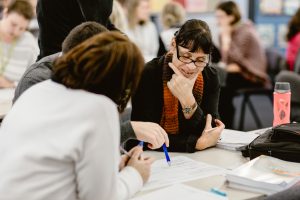
Please note that sessions at this event may be photographed, filmed or recorded by VicTESOL for live or subsequent broadcast via the VicTESOL website. VicTESOL reserves the right to use photos and recordings from the event for publicity and promotional purposes.For more information regarding VicTESOL’s Privacy & Refund Policies, please click here.
We look forward to seeing you there!