2024 VicTESOL Symposium – Panel Discussion

18 November 2024, 4:30pm – 5:30pm

Summary

This panel was held in response to symposium keynote address by Melanie Baak, Refugee education in Australia: what helps, what hinders and what needs to change. The Pannel was facilitated by Victesol committee member, April Edwards. Pannel members from a range of settings including school leadership and refugee support services discuss their experiences of working with students from a refugee background. This included the teaching of English as Additional Language, creating welcoming and inclusive social environments, supporting pathways and supporting wellbeing. The Pannel discussed ways schools can be culturally responsive and importance of supporting wellbeing and being aware of challenges faced within the settlement process and establishment of new lives and identities.

Panelists:

Sarah Cunningham has been employed with CatholicCare Victoria since 2020, coordinating a Job Readiness Program for refugee youth and their mothers in Geelong’s Northern Suburbs.

Debra Gibson is the Principal of Doveton College – a vibrant learning community comprising an Early Learning Centre for children 0-5 years of age, school for Foundation to Year 9 and a range of adult learning classes.

Christine Bakopanos is a Counsellor-Advocate Senior Practitioner at The Victorian Foundation for Survivors of Torture- known as Foundation House. Foundation House provides a range of services to people from refugee and asylum-seeker backgrounds who have survived torture or war related trauma.

Houda El Kheir has been working as a Multicultural Education Aide at Meadows Primary School, in Melbourne’s north for the last 5 years. She works closely with teachers, the principal and the wellbeing team in supporting newly arrived and refugee families to navigate the Australian schooling system.

Recording
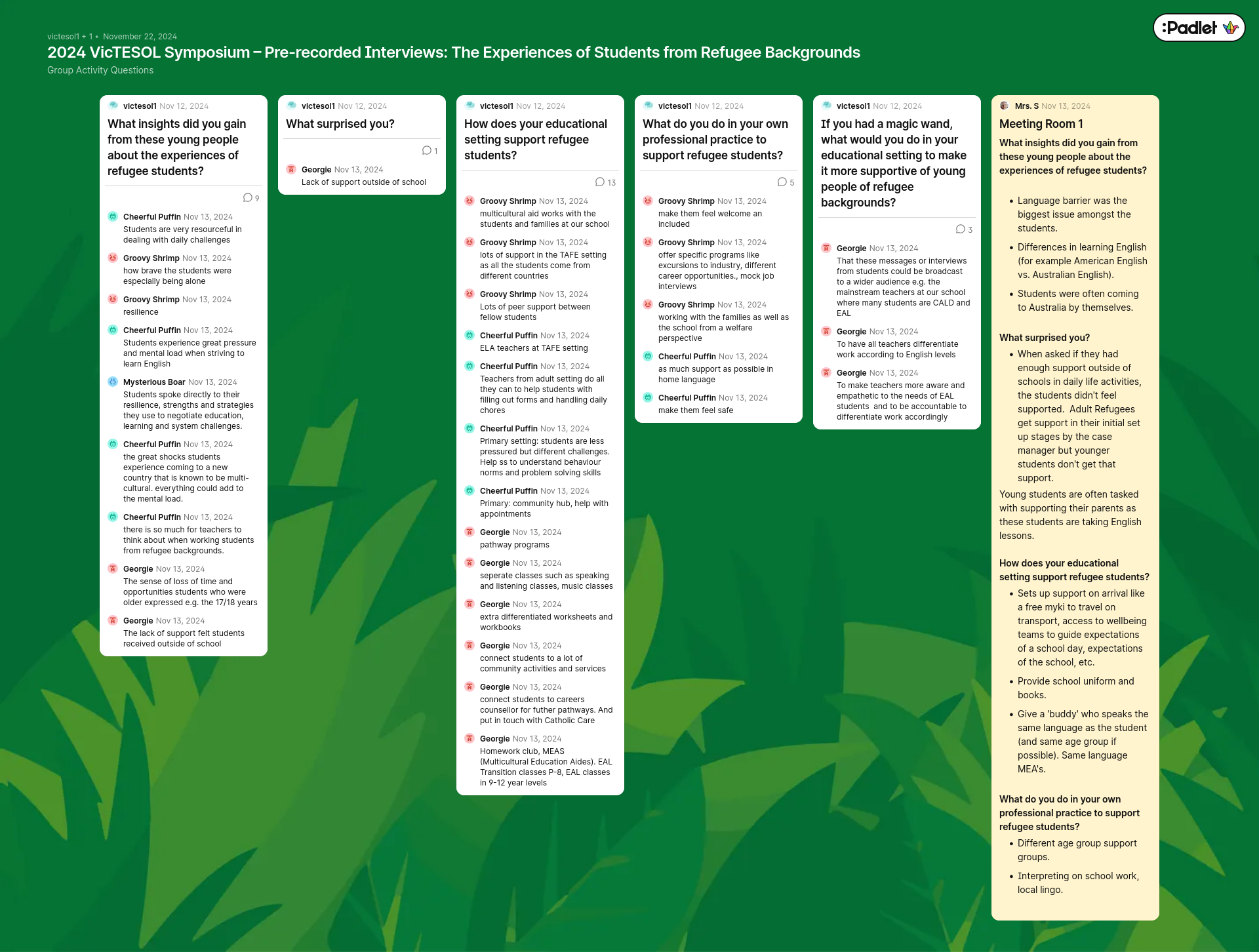
2024 VicTESOL Symposium – Pre-recorded Interviews: The Experiences of Students from Refugee Backgrounds

13 November 2024, 4:30pm – 5:30pm

Summary

Summary to come

Resources

Exploring strategies for educator wellbeing

13 June 2024, 5:15 pm – 6:30 pm AEST

Summary

1. Defining Wellbeing
Alexandra began by defining wellbeing as encompassing the health of the whole person, including physical, mental, social, and emotional aspects. Wellbeing is strongly linked to happiness and life satisfaction, influenced by our surroundings and actions, and can change over time. It’s important to note that wellbeing is not a one-size-fits-all concept and requires long-term, sustainable solutions adapted to individual needs.

2. Frameworks for Understanding Wellbeing at Work
Alexandra introduced the PERMA framework as a tool to understand and enhance wellbeing at work. The PERMA model includes:
Positive Emotions: Experiences that contribute to overall happiness and resilience.
Engagement: Being fully absorbed in activities that balance challenge and skill use.
Relationships: Developing meaningful connections with others.
Meaning: Having a sense of purpose and feeling that one’s work is valuable.
Achievement: Accomplishing goals and feeling a sense of competence and pride.

3. Benefits of Setting Boundaries for Wellbeing
Setting boundaries is crucial for maintaining wellbeing. Alexandra emphasized that boundaries help individuals manage stress, prevent burnout, and maintain a healthy work-life balance. Boundaries allow educators to say ‘no’ when necessary, ensuring they do not take on more than they can handle and protecting their time and energy for activities that support their wellbeing.

4. Strategies for Self-Care to Enhance Job Satisfaction, Resilience, and Wellbeing
Alexandra discussed various self-care strategies, including:
Physical Wellbeing: Engaging in regular physical activity and ensuring adequate rest and nutrition.
Emotional Wellbeing: Practising self-compassion, mindfulness, and seeking support when needed.
Professional Wellbeing: Setting realistic goals, celebrating achievements, and continuing professional development.
Social Wellbeing: Building strong relationships with colleagues and participating in a supportive community.

Alexandra also highlighted the importance of creating sustainable habits and reflecting on individual needs to develop a personalised self-care plan.

By integrating these strategies, educators can improve their job satisfaction, resilience, and overall wellbeing.

Non-native English Language Teachers’ Stories: Constructing Cosmopolitan Professional Identities in Australia
30 April 2024, 4:00 – 5:15pm AEST, Online

Summary

In this professional learning session, Non-native English Language Teachers’ Stories: Constructing Cosmopolitan Professional Identities in Australia, Nashid Nigar shared her recent PhD findings. In her research she interviewed 16 participants, using a hermeneutic phenomenological narrative (HPN) approach, examining the professional identity construction of immigrant English language teachers (ELTs) in Australia, who speak English as a second or additional language. Nashid discussed the concept of “hybrid professional becoming”, which transcends the binary construct of native and non-native ELTs. This allows for a ‘fluid identity shaped over time by transnational professional agency, ideologies of power, race, language, and cultural intersection’.

The session was a powerful showcase of the challenges and opportunities that exist within the Australian education system. It provided valuable insights into the experiences of immigrant ELTs and how we can foster a ‘richer, more inclusive teaching and learning environment’. Attendees were grateful for the learning opportunity and were given the chance to share their own personal and professional experiences.

VicTESOL would like to thank Nashid for generously sharing her research and for her valuable contribution to the VicTESOL professional learning community.

Recording

Resources

Download (PDF, 4.97MB)

The role of schools in supporting settlement: Focusing on wellbeing in migrant and refugee education.

August 30 from 3:30 pm – 5:00 pm, Virtual Event

Summary

This session explored the vital role schools play in the settlement journey of migrant and refugee-background students. Mollie Daphne (Secondary School Teacher & PhD candidate, Victoria University) unpacked key frameworks which support the conceptualisation of settlement as a multifaceted, multidirectional process shaped by various factors. Throughout the session, participants were invited to consider the roles schools can play, through collaboration with other services, towards supporting the academic and social and emotional needs of newly arrived children and young people.

The session also including an engaging panel of presenters who all currently work in schools, supporting newly arrived students: Elena Di Mascolo, Sarah Douglas, Meagan Becker and Megan Salter. The panel discussed the challenges schools face in seeking to address settlement needs and shared examples from their own extensive professional experience of practical ways schools can advocate for and support young people from refugee and migrant backgrounds.

Recording

Resources

Download (PDF, 971KB)

Online LMERC Resourcing Event

September 6 from 4:00 pm – 5:00 pm – Virtual Event

Summary

Participants had the opportunity to learn about Languages and Multicultural Education Resource Centre (LMERC) and the resources and assistance available.

Recording

Resources

Resources to Come


2022 VicTESOL Symposium
Impacts of Traumatic Refugee Experiences on Learning and Behaviour

Allison Green and Matt Roger (Foundation House)

Summary

In their session “Impacts of Trauma on Learning and Behaviour”, Allison Greene and Matt Roger from Foundation House presented insight into the practical strategies and theories to support students impacted by refugee experiences. Allison and Matt began by providing some of the theory around refugee trauma and then invited participants to investigate 2 fictional case studies of students from refugee backgrounds. In small groups, teachers discussed some of the concerns that were evident relating to the students’ learning, engagement and behaviour and then shared some possible strategies to support them in their transition to Australian schooling.
The provision of knowledge and practical examples provided by Allison and Matt, along with the reflective discussion, assisted educators to develop their trauma informed lens. The session allowed for participants to explore connections between trauma reactions and supportive responses, and consider how our various educational settings can be a restorative space for students and families from refugee backgrounds. Participants in the session were given some excellent resources to take away which included further strategies and support for teachers when dealing with students’ trauma reactions and disclosures. For further information, resources and professional learning educators can visit the Foundation House website at https://foundationhouse.org.au/.

Presentation and other Resources

Download (PDF, 1.98MB)

Download (PDF, 1.6MB)

Download (PDF, 1.81MB)

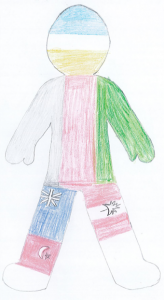
Teaching Resource – Language Portraits

Developed by Kimberley Smith, Blackburn English Language School, in collaboration with Julie Choi, Senior Lecturer in Education (Additional Languages) in the Melbourne Graduate School of Education

This in-class teaching and learning task provides an opportunity for students to explore and communicate their linguistic identities and language practices and the role these play in shaping their experiences as language learners.

Download (PDF, 112KB)

Download (PPTX, 5.56MB)

Download (PDF, 284KB)

Download (PDF, 171KB)

Summary

The VicTESOL professional learning event ‘Supporting young people from a refugee background in the education system’ offered participants valuable insights into working with refugee-background students.  Allison Greene and Madeleine Giummarra from Foundation House (Victorian Foundation for Survivors of Torture and Trauma) explored identifying and responding to trauma reactions and trauma disclosures with students, and how supports connected to the recovery goals can benefit children and young people.  Simone Cassidy and Bojana Popovic from Refugee Minor Program (Dep. of Families, Fairness & Housing) built on this understanding of the refugee experience by walking the audience through a case study, unpacking approaches and strategies that can support and empower young people within the education system.  Bojana and Simone guided the group in focussing on how we as educational professionals can work with students as they navigate educational pathways.  Allison and Madeleine also addressed the important and often under emphasised topic of self care.  They equipped the audience with a picture of what it can look like to become over or under involved within this area of work and how we can aim to achieve a balance in our work with students.  This event provided the audience with ideas that they could implement in their schools immediately, thoughts and considerations for future planning, and also ideas about how educational professionals can balance their involvement and be conscious of self care and caring for colleagues within our work.  VicTESOL would like to extend their sincere thanks and appreciation to Allison, Madeleine, Simone and Bojana for providing the opportunity for us to reflect on this aspect of our work within education.

Recording

Presentations

Foundation House

Download (PDF, 559KB)

Refugee Minor Program

Download (PDF, 554KB)

Resources

Foundation House

Download (PDF, 400KB)

Download (PDF, 3.53MB)

Download (PDF, 1.6MB)

Download (PDF, 356KB)

Refugee Minor Program

Download (PDF, 146KB)

Download (PDF, 1.49MB)

Wednesday 25 August, 2021, 4-5pm

Explore Immigration Museum’s digital resources and content that can expand learning experiences for EAL learners. Museum resources include migration stories, cultural stories, and objects, timelines and personal stories investigating a myriad of Australian identities. This professional learning program was designed for EAL and classroom teachers. Resources can be adapted to suit a variety of subjects, including Humanities, English, Civics and Citizenship. Presented by Immigration Museum Educators in collaboration with VicTESOL.   

Gurmeet Kaur is the Education Program Producer at Immigration Museum and is an experienced former classroom teacher of English and Humanities. She has also worked on international programs such as Teach for Bangladesh and researched intercultural education in schools across Japan, Australia, and UK. Gurmeet studied International Relations and History at the London School of Economics and Political Sciences before completing her qualifications in Education.